Subscribe now & get exclusive bike deals,
new arrivals alerts and pro riding tips!
Cycle green, stay fit, live better.


A complete carbon bike import verification process covers eight categories: supplier legitimacy, quality testing documentation, sample evaluation, contract terms, payment milestones, logistics and customs (HS code 87120030), destination market certifications (CPSC for US, EN 14781 for EU, AS/NZS for Australia), and post-sale support. Skipping any single category exposes the dealer to predictable failure modes — counterfeit suppliers, frames failing customs, warranty coverage gaps, or spare parts unavailability 18 months after purchase. The 35 items in this checklist represent the actual verification points used by experienced dealers across more than 200 wholesale carbon bike imports.
📥 Download the complete 35-point verification PDF with detailed action steps, document templates, and red-flag indicators. Get the free checklist →
Most carbon bike import problems are predictable and preventable. After working with hundreds of bike shop dealers across North America, Europe, Australia, and Japan, the same failure patterns repeat: a deposit paid to a supplier who turns out to be a trading company, not a factory. Frames stopped at customs because the test reports cover a different model than what was shipped. A 200-frame batch arrives with paint defects that were not in the contract specifications. A customer’s frame cracks at month 14 and the dealer discovers the warranty terms exclude their use case.
These problems share a single root cause: gaps in pre-purchase verification. The factory was not actually verified. The test reports were not read carefully. The contract did not specify what “paint defect” means. The warranty was discussed in email but never written into the signed agreement.
The 35-point checklist below is organized into eight categories that map to the actual procurement timeline. Items in earlier categories should be confirmed before progressing to later ones. Skipping forward — for example, signing a contract before validating the factory’s test infrastructure — is the most common reason dealer programs go wrong.
This page covers the 10 most-skipped items at a high level. For the complete checklist with detailed action steps, document templates, and a red-flag scoring system, request the PDF below.
1. Verify the supplier is the actual factory, not a trading company. Request a video call walking through the production floor. Ask to see the molding stage in real time. Trading companies cannot show this.
2. Confirm test reports match the exact frame model and size you are buying. Test reports are model-specific and size-specific. A report for the 54cm frame does not cover the 58cm frame. Generic “EN 14781 certified” claims without per-model documentation are insufficient.
3. Validate the test laboratory is accredited. Reports from non-accredited labs are not accepted at customs in most destination markets. Verify the lab has ISO/IEC 17025 accreditation or equivalent national accreditation.
4. Specify HS code 87120030 (or destination-market equivalent) before shipment. Wrong HS codes trigger customs delays and incorrect duty assessments. The HS code should appear on the commercial invoice, packing list, and bill of lading.
5. Confirm destination market certification before production. US imports require CPSC compliance (16 CFR Part 1512). EU imports require EN 14781 (road) or EN 14764 (city/trekking) plus CE marking. Australian imports require AS/NZS 1927. Confirm the factory’s specific certification documentation, not generic claims.
6. Lock paint and finish standards in writing. “Custom paint” in a contract without written acceptance criteria leads to disputes. Specify acceptable paint defects per square decimeter, color match tolerance (Pantone or measured ΔE), and rejection thresholds.
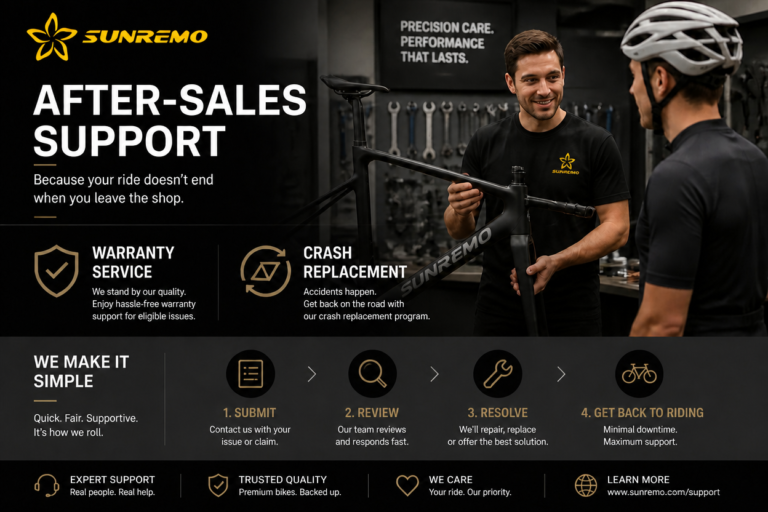
7. Define warranty coverage before deposit, not after delivery. Standard 2-year frame warranty terms vary in what counts as a warrantable defect. Negotiate written terms covering manufacturing defects, paint defects, internal carbon delamination, and crash replacement before signing.
8. Confirm spare parts availability for at least 36 months. Replacement derailleur hangers, headset bearings, and internal cable routing kits must be available long after initial purchase. Factories that cannot commit to 36-month spare parts supply are not long-term partners.
9. Validate the payment milestone structure. 30% deposit on order, 70% balance against bill of lading is standard. Demands for 100% upfront, payments to personal accounts, or payments routed through unrelated entities are all serious warning signs.
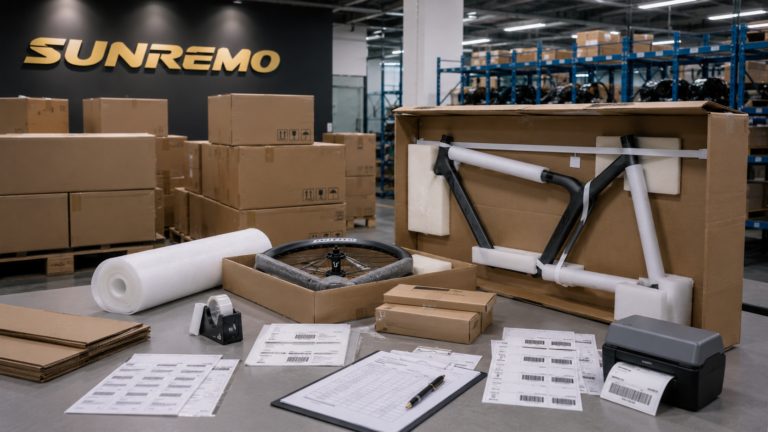
10. Request shipping packaging specifications in writing. Carbon frames damaged in transit are a common dealer complaint. Specify packaging requirements: individual bike boxes with foam protection, fork blocks, dropout protection, internal frame protection, container loading method.
These ten items account for roughly 80% of the import problems we observe across dealer programs. The full 35-point checklist covers the remaining 20%, which prevent the most expensive long-tail issues — the problems that surface 6–18 months after delivery and are far costlier to resolve than to prevent.
The full verification PDF includes:
The PDF is 22 pages, designed for printing as a working checklist during supplier evaluation. Dealers typically use it as a structured framework for first-time imports and as a reference checklist for ongoing supplier reviews.
📥 Get the 35-Point Carbon Bike Import Checklist (PDF)
Send to your email. No spam, unsubscribe anytime. Used by 500+ bike shop dealers across 30 countries.
[Email form: name, email, country, business type (bike shop / distributor / brand / cycling team)]
Is this checklist specific to Chinese suppliers?
The verification framework applies to any carbon bike import. Some details (HS codes, payment routing red flags, IP protection clauses) are particularly relevant when sourcing from China, but the core process applies to imports from Taiwan, Vietnam, Portugal, and other manufacturing regions.
How long does a complete verification take?
First-time supplier verification typically takes 6–10 weeks from initial contact through sample approval. The checklist is structured to run in parallel where possible, compressing the timeline.
Do I need to verify every item for every order?
First-time orders with a new supplier require all 35 items. Repeat orders with an established supplier focus on order-specific items (paint specs, quantities, timing) and skip the foundational supplier verification items already completed.
What if a supplier refuses to provide certain documentation?
Refusal to provide test reports, factory video tours, or written warranty terms are themselves answers. Reputable suppliers respond to verification requests as routine; resistance is a signal.
Does Sunremo provide all the documentation in this checklist?
Yes. Our standard new-dealer onboarding includes verified test reports for every frame model and size, factory video tours, accredited laboratory certificates, written warranty agreements with crash replacement programs, and 60-month spare parts commitments. Contact us to start the verification process.
For dealers beginning a first carbon bike import, download the full PDF and use it as a structured framework for the next supplier conversation. For dealers with existing supplier relationships, use the checklist as a gap audit — most dealers identify 5–8 items they have not formally verified.
For deeper context on specific topics covered in the checklist, see our companion guides on How to Choose a Carbon Bike Supplier, Carbon Frame Quality Testing, and Open Mold vs Private Mold Carbon Bike Frames.