Subscribe now & get exclusive bike deals,
new arrivals alerts and pro riding tips!
Cycle green, stay fit, live better.

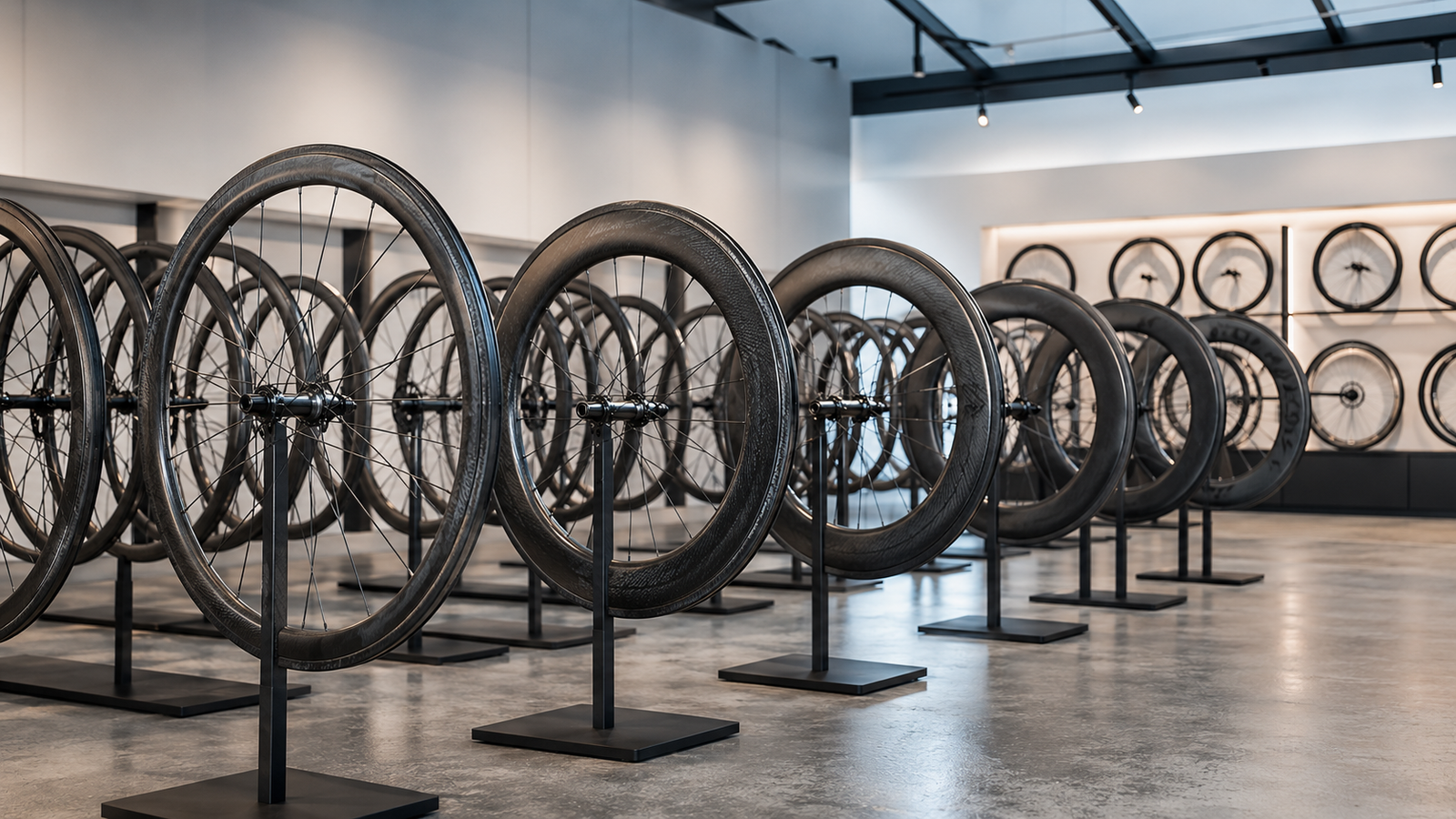
Carbon wheelset wholesale prices from Chinese manufacturers typically range from USD 280 (alloy hub, basic carbon rim) to USD 1,400 (premium hub, high-end rim) per pair at MOQ 10–20 sets. The four core specs that determine fit and price are rim depth (30–88mm), internal rim width (21–25mm), rim profile (hooked or hookless), and hub specification. Standard MOQ for OEM wheelsets is 10 pairs; rim-only programs start at 20 pairs. Production lead time is 25–40 days. The fastest-growing 2026 category is hookless tubeless gravel wheels in 25mm internal width.
| Spec | Common Range | Primary Use |
|---|---|---|
| Rim depth | 30–88mm | Climbing to TT/aero |
| Internal width | 21–25mm | Road to gravel/MTB |
| Rim profile | Hooked / Hookless | Hookless = tubeless, lighter |
| Hub brand | DT Swiss / Industry Nine / house brand | Service network and pricing |
Wheelsets are the highest-margin category most bike shops touch. A complete bike sells once at retail. A premium wheelset upgrade often sells to the same customer 6–18 months later, sometimes multiple times across road, gravel, and event-day setups. Customers who initially buy a USD 3,500 carbon road bike with alloy wheels routinely upgrade to USD 1,200–1,800 carbon wheels within their first year of ownership.
For dealers, stocking carbon wheelsets accomplishes three things at once. It captures upgrade revenue that would otherwise leak to direct-to-consumer brands. It gives entry-level carbon road and gravel customers a clear progression path within the shop. And it creates inventory that serves multiple bike platforms — the same road wheelset fits any 700c rim brake or disc bike with appropriate axle spec, multiplying the addressable customer base per SKU.
The challenge is selection. Wheelset specs are more granular than complete bike specs, and customer expectations around tubeless, hookless, and aerodynamics have shifted significantly since 2022. Dealers stocking from 2021–2022 catalogs are increasingly mismatched to what current customers actually want.
Rim depth is the single most visible spec to customers and the one they ask about first. Modern depth categories have settled into a clear pattern:
| Depth | Primary Use | Wholesale Price Premium |
|---|---|---|
| 25–35mm (shallow) | Climbing, all-road, gravel | Baseline |
| 38–45mm (mid) | All-round road, daily training | +10–15% |
| 50–55mm (deep mid) | Fast group rides, race day | +15–20% |
| 60–65mm (deep) | Crits, flat road races | +20–25% |
| 80–90mm (TT/disc) | Time trial, triathlon, track | +30–40% |
Shallow rims (25–35mm) prioritize low weight and stiffness over aerodynamics. Climbing wheels at 28–30mm depth and 1,300–1,400g weight remain a strong category for hilly markets. This depth also dominates gravel because of crosswind handling on technical surfaces.
Mid-depth (38–45mm) is the volume-selling category. Most amateur and serious riders buy in this range because it balances aerodynamics, weight, crosswind handling, and price. For dealers stocking only one carbon wheelset SKU, 40mm is the safest choice.
Deep mid (50–55mm) appeals to riders prioritizing aero performance over absolute lightness. Crosswind handling has improved significantly with modern rim shapes, making this range usable for daily riding rather than purely race day.
Deep section (60–65mm) targets racers and customers who want maximum visual impact. Crosswind handling becomes more demanding. These wheels sell better in flat regions (Florida, Netherlands, Denmark) than in mountain regions.
Disc and 80mm+ wheels are specialty products for time trial and triathlon. Stock these as special-order rather than inventory. The market is small and customer purchase intent is highly specific.
For first-time wheelset wholesale orders, we recommend a 50/30/20 split: 50% in 38–45mm, 30% in 28–35mm, 20% in 50–55mm. Adjust based on local terrain.
Rim depth gets attention. Internal width determines whether the wheel actually works for the customer’s tires. Modern internal width has shifted significantly upward as tire trends evolved.
| Internal Width | Tire Range | Primary Application |
|---|---|---|
| 19–20mm | 23–28mm tires | Older road wheels, race-only |
| 21mm | 25–32mm tires | Modern road standard |
| 23mm | 28–35mm tires | All-road and endurance road |
| 25mm | 32–45mm tires | Gravel and adventure road |
| 27–30mm | 38–55mm tires | Wide gravel and bikepacking |
| 30mm+ | MTB tires | Cross-country and trail MTB |
The shift toward wider tires is the most significant wheel design trend of the past decade. The current road peloton has standardized on 28–30mm tires, and even climbing wheelsets have moved from 19mm to 21mm internal width. Endurance and all-road riders now commonly run 32mm tires on 23mm internal rims.
For wholesale dealers, the practical implication is straightforward: stock 21mm internal as the road minimum, 23mm for all-road versatility, and 25mm for gravel. Anything narrower than 21mm internal is functionally obsolete for new road bike sales in 2026.
A common dealer mistake is matching deep rim depth with narrow internal width to chase pure aero numbers. Modern aero theory increasingly favors slightly shallower depths with wider internal widths, because the wider rim better supports modern tire profiles for combined system aerodynamics. A 45mm × 23mm internal wheel often outperforms a 60mm × 19mm internal wheel for real riders on real tires.
This is the spec that creates the most confusion at the retail counter, and the one where misinformation causes real safety issues.
Hooked rims have a small inward-curving bead lip that mechanically retains the tire bead under pressure. They accept a wide range of tire brands and pressures, work with traditional clincher tires (with tubes) and tubeless tires, and tolerate higher pressures (typically rated up to 120+ psi).
Hookless rims have a straight vertical bead seat with no hook lip. The tire bead is retained purely by friction and tight tolerances. Hookless rims are lighter (no hook material), simpler to manufacture, and offer a smoother tire-to-rim transition for aerodynamics. The trade-offs are real: hookless requires tubeless-specific tires from approved manufacturers, mandates lower maximum pressures (typically 72.5 psi / 5 bar maximum on road), and has stricter tire-rim compatibility lists.
| Factor | Hooked | Hookless |
|---|---|---|
| Tire compatibility | All clincher and tubeless | Tubeless only, approved list |
| Maximum pressure | 120+ psi | 72.5 psi (road), varies for gravel/MTB |
| Manufacturing cost | Higher | Lower |
| Weight | Slightly heavier | Slightly lighter |
| Aero performance | Standard | Slightly better |
| Customer education needed | Minimal | Significant |
| Dealer service complexity | Low | Higher |
For dealers, the practical reality is that hookless is correct for most modern carbon road and gravel wheelsets being designed for tubeless use, but customers must be educated. Selling a hookless wheelset to a customer who plans to run their existing high-pressure clincher tires creates an unsafe condition and a likely warranty claim.
Critical safety note: never approve a wheelset for use with a tire not on the rim manufacturer’s compatibility list when running hookless. The pressure ratings are not optional. Tires can blow off hookless rims at higher pressures, with serious injury risk.
For wholesale stocking, a balanced approach is hooked rims for entry and mid-tier carbon wheels (USD 350–800 wholesale tier), and hookless for premium tubeless-focused wheels (USD 800+ wholesale tier). This matches customer sophistication to product complexity.
Modern carbon wheels are essentially all tubeless-ready, but the actual setup quality varies significantly between manufacturers. Three factors determine whether tubeless setup is straightforward or maddening:
Bead seat tolerance. The internal bead seat diameter tolerance must be tight (typically ±0.3mm) for reliable tire seating. Cheaper carbon rims with loose tolerances either fail to seat tires or seat them inconsistently across the rim circumference, causing slow leaks.
Bead seat profile. A proper tubeless bead seat has a defined “bump” or “shelf” that helps the tire bead lock into place at the correct diameter. Rims without this profile, even if they are technically tubeless-compatible, are difficult to set up and prone to bead displacement under hard cornering.
Spoke hole sealing. Tubeless rims either use a sealed rim bed (no spoke holes through to the tire chamber) or require tape application. Sealed rim beds are preferred for reliability. Tape-required rims work fine if the tape is applied correctly but introduce a service variable.
When evaluating wholesale wheelsets, request the manufacturer’s tubeless compatibility data: which tire brands and models have been verified to seat reliably, what sealant volume is recommended, and what valve length matches the rim depth. Manufacturers that cannot provide this data are typically selling rims that have not been validated for tubeless beyond a generic “tubeless-ready” sticker.
Sample 2–3 tire brands across a wholesale order before committing to high volume. Continental GP5000 S TR, Pirelli P Zero Race TLR, Schwalbe Pro One TLE, and Vittoria Corsa Pro TLR are common reference tires for road testing. Maxxis Rambler EXO TR and Schwalbe G-One R are common gravel references.
The hub is the single most important component for wheelset durability and serviceability. A premium rim built around a poor hub is a poor wheelset.
Premium branded hubs (DT Swiss 240/180, Industry Nine Hydra, Chris King R45, Onyx Vesper) carry strong customer recognition and global service networks. Wholesale wheelsets built around these hubs price 30–60% higher than house-brand alternatives. Customer willingness to pay for branded hubs is real but plateaus around the USD 1,000+ wheelset price tier.
Mid-tier branded hubs (DT Swiss 350, Bitex, Novatec Premium) offer good engagement, reliability, and service parts availability without the premium pricing. These hubs power the volume-selling carbon wheelset segment.
House-brand hubs developed by carbon wheel manufacturers vary widely in quality. Top-tier Chinese factories produce house-brand hubs with comparable engagement and bearing quality to mid-tier branded hubs at significantly lower cost. Bottom-tier house-brand hubs are unreliable and create warranty headaches.
| Hub Tier | Engagement Points | Wholesale Premium | Customer Recognition |
|---|---|---|---|
| Premium branded (Industry Nine Hydra) | 690 | +40–60% | Very high |
| Premium branded (DT 240/180) | 36–54 (or upgradeable to 36/54) | +35–50% | Very high |
| Mid-tier (DT 350) | 18–36 (upgradeable) | +20–30% | High |
| Mid-tier (Bitex, Novatec Pro) | 24–36 | +10–20% | Medium |
| House brand premium | 36–60 | Baseline | Low to medium |
| House brand standard | 18–24 | -10–15% | Low |
For dealer stocking, a smart strategy offers two hub options per rim model: a house-brand version at the entry price point, and a DT Swiss 350 or 240 upgrade at a defined premium. This gives customers a clear upgrade decision and captures the willingness-to-pay across the customer spectrum.
Engagement points matter most for technical riding (gravel, MTB, criterium) where instant pedal response affects performance. For pure road riding, anything above 24 engagement points is functionally adequate. Industry Nine’s 690 points is a marketing differentiator more than a meaningful performance differentiator on road, but customers care.
Spokes are the least visible spec to customers but materially affect ride quality and durability.
Stainless steel bladed spokes (Sapim CX-Ray, DT Swiss Aerolite) are the durability standard. Cost-effective, time-tested, easy to service, and available globally for replacement. Suitable for all wheel categories from training to race.
Carbon spokes are increasingly available on premium wheelsets, with weight savings of 60–100g per wheel pair versus steel spokes. The trade-offs are higher cost (+USD 150–300 per wheelset wholesale), more limited service availability, and (in cheap implementations) potential durability issues. Premium carbon spoke implementations from established brands (Berd, Lightweight) are reliable; budget carbon spokes from unverified sources should be avoided.
Round vs bladed spokes: bladed spokes offer marginal aero benefit and prevent spoke wind-up during truing. Round spokes are simpler and cheaper. For carbon wheels in the dealer wholesale segment, bladed is the standard expectation.
Lacing patterns: most modern carbon wheels use 24h front, 24h rear (or 20/24) for road, and 28h or 32h for gravel and heavier-duty applications. Avoid wheelsets with fewer than 20 spokes per wheel for any non-race application — the lower spoke count concentrates load and reduces real-world durability.
For wholesale orders, specify spoke brand, model, gauge, and count in writing. Vague spec language (“bladed stainless spokes”) frequently means substitutions during production with lower-grade spokes from unverified suppliers.
Carbon wheelset wholesale pricing in 2026 spans a wide range based on rim quality, hub spec, and spoke choice. Indicative ranges per pair at MOQ 10–20 sets, FOB China:
| Tier | Rim Spec | Hub Spec | Wholesale Price (USD) | Suggested Retail (USD) |
|---|---|---|---|---|
| Entry carbon | Hooked, 21mm internal, basic | House brand standard | 280–400 | 700–1,000 |
| Mid-tier road | Hooked, 21mm internal, validated | House brand premium / Bitex | 400–600 | 1,000–1,500 |
| Premium road tubeless | Hookless, 21–23mm internal, validated | DT Swiss 350 | 600–850 | 1,500–2,200 |
| High-end road | Hookless, 23mm internal, premium | DT Swiss 240 / Industry Nine | 850–1,200 | 2,200–3,000 |
| Premium gravel | Hookless, 25mm internal | DT Swiss 350 / 240 | 650–950 | 1,600–2,400 |
| Premium MTB XC | Hookless, 28–30mm internal | DT Swiss / Industry Nine | 700–1,100 | 1,800–2,800 |
| Carbon spoke premium | Hookless, validated, premium hub | DT 180 / I9 Hydra + carbon spokes | 1,100–1,500 | 2,800–3,800 |
Per-pair price drops 8–12% at MOQ 50 and 12–18% at MOQ 100+. For dealers placing first orders, MOQ 10 at standard wholesale pricing is the typical entry point.
Carbon wheel manufacturers typically offer two procurement models:
Complete wheelsets ship fully built (rim, hub, spokes, tape, valves, decals) ready for customer fitting. This is the standard for dealer wholesale because it requires no in-house wheel-building capability. Complete wheelsets carry the manufacturer’s warranty as a complete system.
Rim-only programs ship rims for the dealer or a partner wheelbuilder to assemble with chosen hubs and spokes. This appeals to dealers with in-house wheelbuilding and wholesale buyers serving the high-end custom market where every customer wants different hub and spoke choices. Rim-only typically prices 35–50% below the equivalent complete wheelset.
| Factor | Complete Wheelset | Rim-Only |
|---|---|---|
| MOQ | 10 pairs | 20 rims (10 pairs) |
| Lead time | 25–40 days | 20–30 days |
| In-house wheelbuilding required | No | Yes |
| Warranty coverage | System warranty | Rim only |
| Margin potential | Standard | Higher (custom build premium) |
| Inventory complexity | Lower | Higher (rims + hub + spoke inventory) |
For most dealer operations, complete wheelsets are the right choice. Rim-only programs make sense for shops with established wheelbuilding services and customers who specifically value custom builds.
Custom decals on carbon wheelsets work the same way as custom paint on frames, with similar economics:
Stock decals with dealer logo are typically included free at MOQ 10+. The factory uses a default decal layout with your dealer or brand name applied.
Custom decal design runs USD 8–15 per pair additional, covering custom logo files, color matching, and decal cutting. This is the standard approach for dealers building house-brand wheelsets.
Painted finishes (full rim color matching, fades, color-shift) are available on premium programs at USD 30–60 per pair additional. Most dealers stick with raw carbon weave under clear coat plus custom decals because customers in the carbon wheel segment generally prefer the carbon aesthetic.
For dealers building a serious house-brand wheelset program, allocate USD 500–1,500 for one-time decal die and printing setup. This investment is amortized across all subsequent wheelset orders and produces significantly more professional results than self-applied vinyl decals.
Buying on rim depth alone without verifying internal width. A 50mm deep rim with 19mm internal width is a 2018 spec. Customers running modern 28–32mm tires get poor performance and complain.
Mixing hookless rims with hooked-only tires in customer hands. This is the most dangerous error. Train sales staff and provide clear customer-facing documentation about tire compatibility for hookless wheels.
Underestimating hub serviceability. A customer with a failed bearing on a mystery house-brand hub at month 14 is a problem. Stock wheelsets from manufacturers who provide spare bearings, freehubs, and service support, or use branded hubs with established service networks.
Vague spoke spec acceptance. “Bladed stainless” without brand and model specification opens the door to spoke substitution with lower-grade products. Specify exact spoke brand and model in writing.
Ignoring tubeless validation data. Generic “tubeless-ready” claims without specific tire compatibility lists lead to customer setup failures. Request validation data before ordering.
Overstocking deep-section wheels in mountain markets. A 65mm deep wheelset is hard to sell in markets where 80% of customers ride hilly terrain. Match inventory to local terrain.
Industry-standard warranty terms for wholesale carbon wheelsets:
| Component | Standard Warranty |
|---|---|
| Carbon rim (manufacturing defect) | 2 years |
| Hub bearings | 1 year |
| Spokes | 1 year |
| Decals and finish | 6 months |
| Crash damage | Not covered |
Premium programs sometimes offer 5-year limited warranties on rims and crash replacement programs (replacement rim at 40–50% of wholesale price after a documented impact). Crash replacement is increasingly a customer-facing differentiator and worth negotiating into wholesale agreements.
Spare parts availability is critical for wheelsets more than for frames. Confirm with the factory:
A factory that cannot supply spares 12 months after a wheelset purchase is not a long-term wholesale partner.
Total timeline from order to dealer warehouse: 50–70 days including sea freight. Plan inventory accordingly.
What internal rim width should I stock for road wheels in 2026?
21mm is the modern road minimum. 23mm is the strong choice for all-road and endurance road. Anything narrower is functionally outdated for new road bike sales.
Should I stock hooked or hookless wheelsets?
Both, at different price tiers. Hooked is appropriate for entry and mid-tier carbon wheels (USD 350–800 wholesale). Hookless is appropriate for premium tubeless-focused wheels (USD 800+ wholesale). Hookless requires customer education about tire compatibility and pressure limits.
What’s the MOQ for OEM carbon wheelsets?
10 pairs is the typical minimum for complete wheelsets with custom decals. Rim-only programs start at 20 rims (10 pairs equivalent).
How much do branded hubs add to wholesale cost?
DT Swiss 350: +USD 80–130 per pair. DT Swiss 240: +USD 200–280 per pair. Industry Nine Hydra: +USD 250–350 per pair.
Can I mix hub options across the same rim model?
Yes. Most factories allow hub configuration per pair within a single order, as long as the total order meets MOQ.
What’s the lead time for wheelset production?
25–40 days production for complete wheelsets, plus 30–45 days sea freight. Total 55–85 days from deposit to warehouse.
Are carbon spokes worth the premium?
For weight-conscious customers in the USD 2,500+ retail segment, yes. For mid-tier customers, the cost-benefit is poor. Bladed stainless steel from Sapim or DT Swiss is the durability and value standard.
How do I evaluate tubeless validation quality?
Request the manufacturer’s tubeless test data: specific tire brands and models verified, sealant volume recommendations, valve length matching by rim depth, bead seat tolerance specs. Manufacturers without this documentation have not seriously validated tubeless performance.
Does Sunremo offer both complete wheelset and rim-only programs?
Yes. We supply complete wheelsets (assembled with house-brand or DT Swiss hubs, Sapim spokes, custom decals) at MOQ 10 pairs, and rim-only programs at MOQ 20 rims for dealers with in-house wheelbuilding. Contact us for current catalog and tubeless validation data.
For dealers expanding carbon wheelset programs, request our current wheelset catalog with full specs, hub options, tubeless validation data, and 2026 wholesale pricing. We supply wheelset programs to dealers across North America, Europe, Australia, and Japan, with sample pairs available for evaluation before commitment.
For dealers building integrated carbon programs covering complete bikes and wheelsets, see our companion guides on Carbon Road Bike Wholesale and Carbon Gravel Bike Wholesale.