Subscribe now & get exclusive bike deals,
new arrivals alerts and pro riding tips!
Cycle green, stay fit, live better.

Bike Shops and Dealers
Choosing a carbon bike supplier is the single highest-leverage decision a bike shop or dealer makes. The wrong supplier ties up cash in unsellable inventory, exposes the shop to warranty claims it cannot recover from, and damages the customer relationships that took years to build. The right supplier compounds margin every season.
This guide gives you a 7-criteria framework to vet any carbon bike supplier — Chinese, Taiwanese, European, or domestic — based on the actual purchasing patterns of bike shops moving 50 to 5,000 units per year. It is written for buyers who already understand the bike industry and want a rigorous filter, not a sales pitch.
A qualified carbon bike supplier should clear all seven of the following bars. If a supplier fails on more than one, walk away.
The rest of this article unpacks each criterion, explains the four types of suppliers you will encounter, lists the red flags that signal trouble, and ends with a ready-to-use procurement checklist.
Carbon bike manufacturing has consolidated dramatically over the past decade. Most premium global brands — including the majority of WorldTour sponsor brands — outsource their frames to a small number of factories in Taiwan, China, and Vietnam. This means a $2,000 frame and a $6,000 frame can roll out of the same campus, sometimes the same hall, separated only by spec, paint, and brand premium.
For a dealer, this is both opportunity and risk. The opportunity is access to factory-grade quality at OEM pricing. The risk is that the appearance of a frame says nothing about how it was actually built. Two frames that look identical can have different resin content, different layup schedules, different cure profiles, and dramatically different fatigue life. Selecting a supplier means looking past the surface.
Suppliers fall into four functional categories. Knowing which one you are talking to changes every other question you ask.
Trading companies do not own factories. They aggregate orders and place them with whichever factory is cheapest that quarter. Margins are thin, communication is fast, but quality control is whatever the underlying factory provides. Use only for low-stakes pilot orders or non-critical accessories.
OEM factories manufacture to your specifications, your design, your mold. You own the IP and tooling. Price is highest, lead times are longest, but the brand identity is fully yours. This is the model for established brands and serious DTC start-ups.
ODM factories offer existing platforms (open molds or semi-custom variants) that you can rebrand, repaint, and re-spec. You get to market faster with lower capital outlay, in exchange for sharing the underlying chassis with other clients. This is the practical entry point for most dealers and emerging brands.
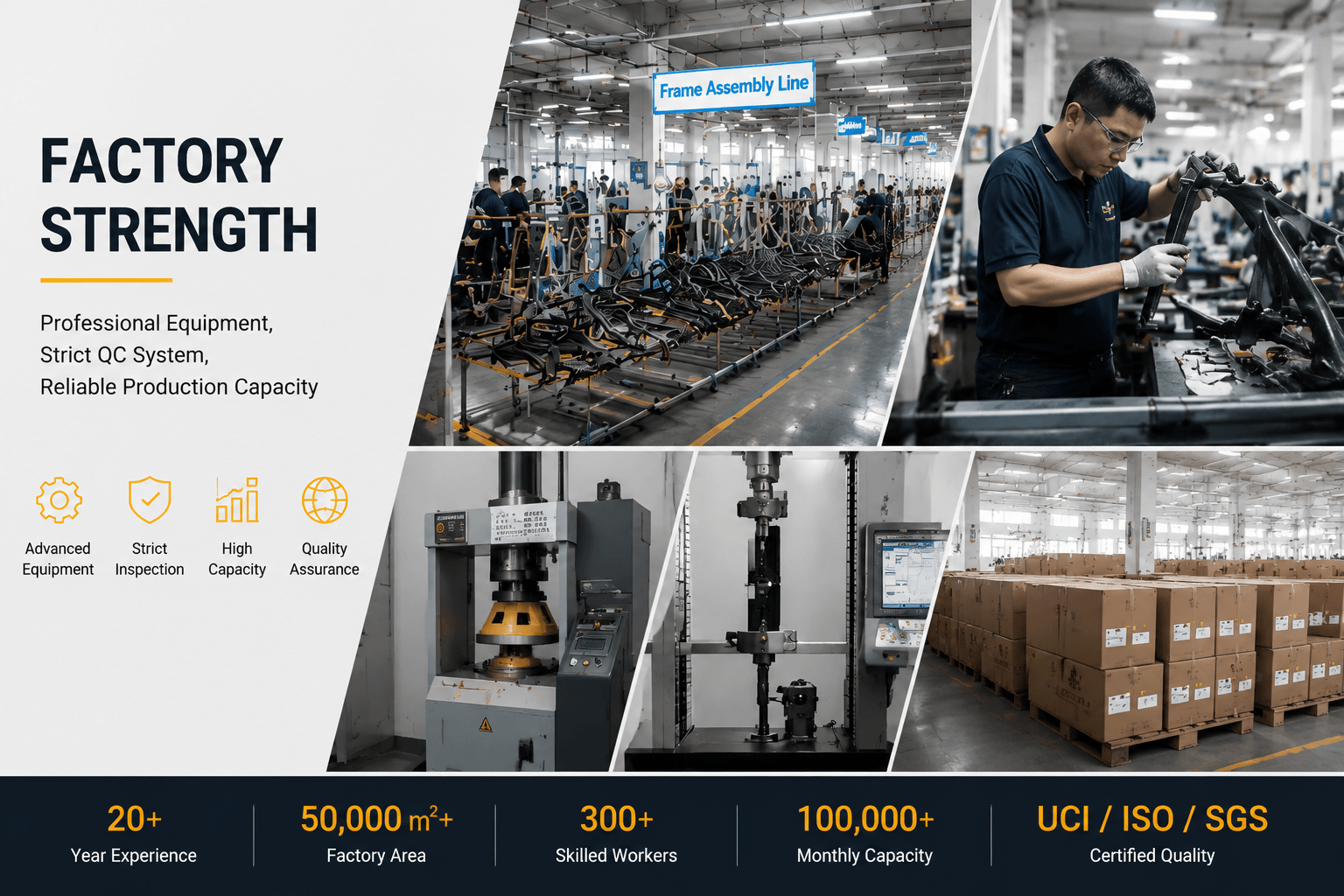
Full-stack manufacturers like Sunremo combine ODM platforms with private-mold capability under one roof, plus in-house design, testing, painting, and assembly. The advantage is single-source accountability — one team owns the outcome from layup to logistics.
Ask for ISO 4210-2 (city/trekking), ISO 4210-6 (road), ISO 4210-9 (mountain), EN 14781 (road racing), and CPSC certification if you sell into the United States. Reports must be:
Verify the report by emailing the issuing lab with the report number. Reputable labs respond within 48 hours. If the supplier resists, that is your answer.
A supplier moving 200 frames a month cannot reliably deliver a 500-frame seasonal order without delaying other clients. Ask for:
Sunremo currently operates 2000m² of carbon production floor with 3000 units of monthly capacity. Capacity transparency is a baseline expectation, not a trade secret.
A supplier who refuses to negotiate MOQ on a first order is signaling that you are not the customer they want. Reasonable MOQ structures look like this:
| Order type | Typical MOQ | Mold cost | Lead time |
|---|---|---|---|
| Open mold rebrand | 30–50 units | $0 | 45–60 days |
| Semi-custom (geometry tweak, custom paint) | 100–200 units | $3,000–$8,000 | 60–90 days |
| Private mold (full custom) | 200–500 units | $30,000–$80,000 | 6–9 months to first production |
Lower MOQs are possible for sample/pilot runs. Higher MOQs may be required for unusual sizes or unusual color counts.
The industry standard is 30% deposit at PO, 70% balance before shipment, against pro-forma invoice. Variations that are normal:
Be cautious of suppliers asking for 100% upfront, unusual third-party bank accounts, or payment to personal accounts. Cross-reference the bank account name with the supplier’s business license. They must match exactly.
This is where shops and emerging brands lose the most money long-term. The contract must specify in writing:
A supplier who refuses to put any of this in writing is reserving the right to walk away with your investment. Walk first.
A supplier who hits 90% on-time delivery across 12 months is a partner. A supplier who hits 60% is an unbudgeted line item in your P&L. Ask for:
The honest answer to “have you ever missed a deadline” is yes. The useful follow-up is “how often, why, and how did you handle it.”
A frame failure six months into the season is not an isolated event. It is a test of whether the supplier is a vendor or a partner. Confirm in writing:
For specific warranty details, please refer to our Warranty Policy page.
The following signals correlate strongly with downstream problems. Any one of them is a serious warning. Two or more should end the discussion.
The supplier refuses to share factory video walkthroughs. The test reports they provide are summaries rather than full PDFs from the lab. The bank account name does not match the company name on the business license. The supplier cannot name the lab that issued their certifications. They will not put mold ownership in writing. They have no engineer-level contact, only sales staff. They cannot provide three reference customers in your region. Their pricing changes more than 10% during quotation without a clear material cost driver.
For dealers and shops new to a supplier, the full cycle from first inquiry to landed inventory typically runs 14 to 22 weeks for an ODM order, longer for OEM:
Weeks 1–2: Initial inquiry, capability deck, NDA exchange.
Weeks 2–4: Quotation, sample request, payment terms finalized.
Weeks 4–8: Sample production and delivery for evaluation.
Weeks 8–10: Sample feedback, contract finalization, deposit paid.
Weeks 10–18: Bulk production.
Weeks 18–20: QC, packaging, shipment booked.
Weeks 20–22: Ocean freight (US/EU), customs clearance, delivery.
Air freight on small shipments compresses the last three weeks to about five days at higher unit cost.
These five questions, asked early, separate serious suppliers from the rest:
What is your monthly output for road frames specifically, not all categories combined. Which independent lab issued your most recent ISO 4210 report and can I have the report number to verify. What is your warranty failure rate over the last 24 months. Who owns the mold if I order a private mold with you. Can you connect me with two existing dealer clients in my region for reference.
A supplier who answers these five clearly and quickly has done this before. A supplier who hesitates is learning on your order.
What is the minimum order quantity for carbon bike frames?
Most reputable manufacturers accept 30–50 frames for open-mold rebranding, 100–200 for semi-custom, and 200–500 for private mold. Lower MOQs may be available for first samples or pilot runs.
How long does it take to develop a custom carbon bike frame?
Full private-mold development from concept to first production typically takes 6–9 months, including CAD design, CFD analysis for aero models, FEA structural validation, T1 prototype, lab testing, and T2 production sample sign-off.
What certifications should a carbon bike supplier provide?
At minimum: ISO 4210 (the relevant section for the bike category), EN 14781 for road racing bikes, CPSC for the US market, and CE / UKCA where applicable. Reports must be from accredited labs and dated within 24 months.
How do I verify a Chinese carbon bike supplier is legitimate?
Cross-check the business license on the National Enterprise Credit Information Publicity System, confirm the bank account name matches the registered company name exactly, verify lab reports by contacting the issuing lab directly, and request video factory walkthroughs.
What is a fair payment term for carbon bike orders?
30% deposit at PO and 70% balance against pro-forma invoice before shipment is standard. New buyers may face 50/50 terms. L/C at sight is common for orders above USD 100,000.
Should bike shops buy frames or complete bikes from a manufacturer?
Complete bikes have lower per-unit margins but eliminate assembly labor and component sourcing complexity. Framesets allow shops to spec components to local market preferences and capture assembly margin. Most shops doing under 200 units annually start with complete bikes.
Who owns the mold in a private mold carbon bike order?
Whoever pays for the mold should own it, and this must be written into the manufacturing agreement. Mold ownership, storage location, exclusivity terms, and termination handling are non-negotiable contract clauses.
What is the typical warranty on a carbon bike frame from a Chinese manufacturer?
Reputable manufacturers offer 5 years on the frame structure and 2 years on paint. Warranty terms should specify response SLA, replacement vs. repair, and whether crash replacement is available.
Next step for dealers and bike shops: If you are evaluating Sunremo as a potential supplier, our team can provide capability documentation, recent test reports, and reference contacts within 48 hours. Contact our B2B team.