Subscribe now & get exclusive bike deals,
new arrivals alerts and pro riding tips!
Cycle green, stay fit, live better.


Learn how B2B bicycle buyers can verify carbon frame material, process, traceability, sample, weight and factory evidence before ordering.
Carbon frame manufacturing evidence is the set of records that connects a product claim to a specific material, process, sample, inspection, or production batch. A useful evidence package may include a model specification, material identification, controlled drawings, sample approval records, inspection criteria, test documents, packaging records, and a clear revision history.
No single photo, certificate, factory video, or carbon-fiber grade proves that a finished frame is suitable for a buyer's market. B2B buyers should evaluate evidence as a chain: identify the exact model, confirm which claim is being made, request the record that supports it, and check whether the record applies to the quoted version and order.
This guide is an educational framework. It does not state that every supplier or every Sunremo product uses the same materials, processes, documents, or test program. Project-specific evidence must be confirmed during model selection and quotation.
Carbon bicycle frames are difficult to compare from photographs alone. Two products can look similar while differing in material selection, reinforcement, hardware, finish, quality controls, and revision status. Conversely, two frames described with different marketing language may share many ordinary manufacturing principles.
For dealers, distributors, importers, and private-label brands, the practical question is not whether a supplier uses impressive terminology. It is whether the buyer can connect the quoted product to reliable, current, model-specific information.
Manufacturing evidence supports four decisions:
Evidence loses value when it cannot identify the product it describes. A generic material brochure may explain a fiber family, but it does not show which fiber or prepreg is used in a particular frame. A test report may be legitimate, but it may cover a different size, revision, fork, or configuration. A factory video may show real equipment without showing who owns the facility or which production line made the quoted model.
Ask whether every important record identifies:
When confidentiality prevents a supplier from sharing a full document, a redacted extract can still be useful if it preserves the model, revision, date, issuer, and conclusion needed for the buyer's decision.
| Evidence level | Typical example | What it can support | Main limitation |
|---|---|---|---|
| Marketing statement | Product page or sales presentation | Identifies a claim to investigate | Not independent proof |
| Product specification | Geometry, interfaces, included parts, finish | Defines the quoted product | May not show how it is controlled |
| Process record | Material receipt, inspection checklist, traveler, approval form | Connects work to a model or batch | Often confidential or partial |
| Test or inspection record | Internal inspection or third-party report | Supports a defined check or test | Scope may differ from the order |
| Independent market evidence | Review, customer case, public document | Adds external context | May cover another unit or version |
The goal is not to collect the largest number of documents. It is to assemble enough relevant evidence to reduce a specific purchasing risk.
Material evidence should answer more than "Is this T700, T800, or T1000?" Commercial carbon-fiber names identify fiber families or grades, not complete frame performance. The finished laminate also depends on resin, fiber form, orientation, ply placement, consolidation, curing, and quality control.
Useful questions include:
For a deeper explanation, review T700 vs T800 vs T1000 Carbon Fiber.
Prepreg is a time- and temperature-sensitive input. Buyers do not normally need confidential shop-floor records, but they should understand whether the supplier can identify incoming material, storage controls, material issue, and the batch used for an approved sample or production order.
A practical evidence request may include a redacted material receipt, lot reference, storage-control description, and an explanation of how issued material is linked to a work order. The appropriate evidence depends on the supplier and project.
See Carbon Prepreg Storage and Traceability for a buyer checklist.
The mold defines external geometry, but it does not define the entire laminate. Ply orientation, local reinforcement, material combinations, overlap positions, and process instructions can change the behavior and consistency of a frame.
Buyers do not need a supplier's proprietary layup schedule. They do need clarity about version control: which approved specification applies, how changes are authorized, and how the bulk order is kept consistent with the approved sample.
Read Carbon Frame Layup and Revision Control for the difference between confidential engineering detail and the records a buyer can reasonably request.
Frame weight is often quoted without a complete measurement definition. Size, paint, hardware, protective parts, seatpost, fork, and measurement equipment can all change the displayed number.
A useful weight statement identifies:
The guide Carbon Frame Weight Claims explains how to compare weight data without assuming one sample represents every unit.
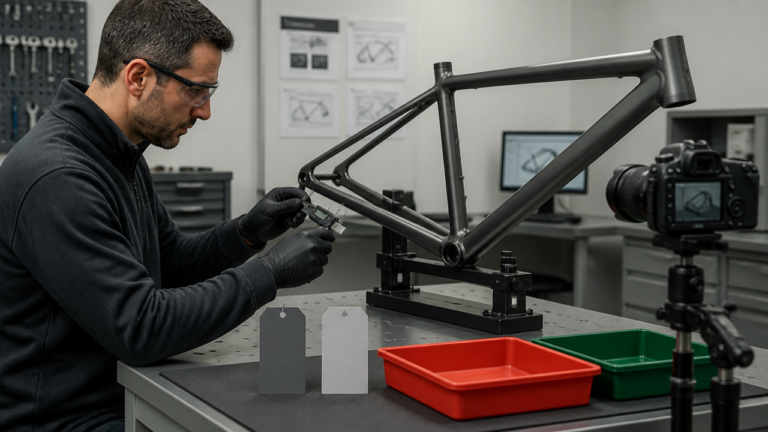
A sample is valuable only when the buyer records what was approved. A complete approval package may include photographs, measured specifications, finish references, packaging, included small parts, drawing revision, and unresolved deviations.
The approved sample should become a reference for production, not an informal memory. Any later material, hardware, color, tooling, or specification change should follow a documented review path.
Use Golden Sample and Change Control for Carbon Frame OEM Orders with the existing carbon bike sample order strategy.
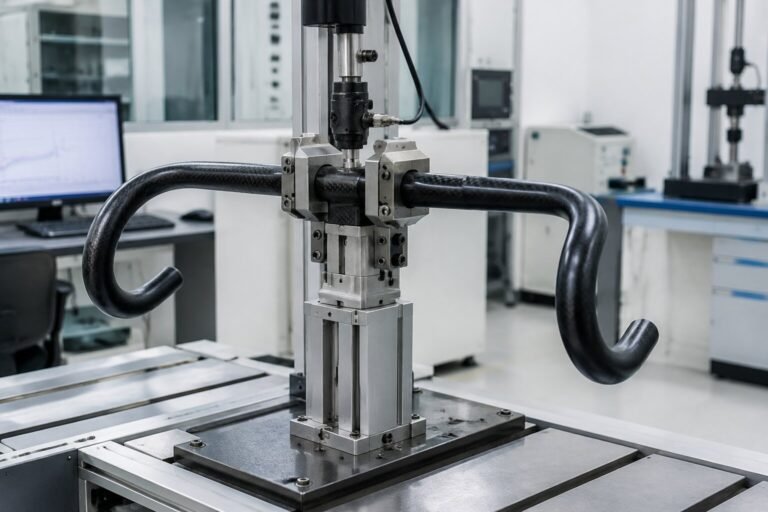
Testing and inspection answer different questions. A laboratory report may show how a defined sample performed under a defined method. Incoming, in-process, and final inspections help control repeat production. Neither should be treated as universal proof for every product a supplier sells.
Before relying on a report, confirm the model, revision, size or configuration where relevant, issuer, date, referenced method, and conclusion. Do not assume that a report for one frame covers every related frame, fork, wheel, or complete bicycle.
Sunremo's existing carbon frame quality testing guide should be used as educational material and reviewed against current, model-specific documents before commercial decisions.
Factory photos and videos can show equipment, workflow, inspection points, people, and product handling. They cannot by themselves prove ownership, capacity, certification, material identity, or that the quoted product was made in the location shown.
Stronger visual evidence includes a dated, continuous walkthrough; recognizable process stages; model or work-order references where confidentiality permits; and links to supporting documents. Learn more in How to Evaluate a Carbon Bike Factory Video.
Before approving a sample or bulk order, record:
Sunremo buyers can use the Manufacturing Evidence Center, B2B Bicycle Manufacturing Hub, and OEM RFQ template to organize these questions.
No. It describes one material input. Finished-frame performance and consistency depend on the complete laminate, design, process, and quality controls.
Usually not. A full layup schedule may be confidential intellectual property. Buyers should instead confirm the approved revision, change-control process, and evidence that production follows the agreed specification.
No. It is useful visual context, but it should be checked alongside company, product, process, sample, and document evidence.
Do not assume so. Check the report's model, sample, revision, configuration, method, and stated scope.
Treat the related claim as unverified, reduce its weight in the decision, request an alternative record, or make verification a condition of sample or order approval.
Review the Sunremo Manufacturing Evidence Center and send a model-specific request through the OEM/ODM service. Include the product category, destination market, sample stage, and documents you need reviewed.
Related buyer resource: Chinese carbon frame manufacturer evaluation guide.