Subscribe now & get exclusive bike deals,
new arrivals alerts and pro riding tips!
Cycle green, stay fit, live better.

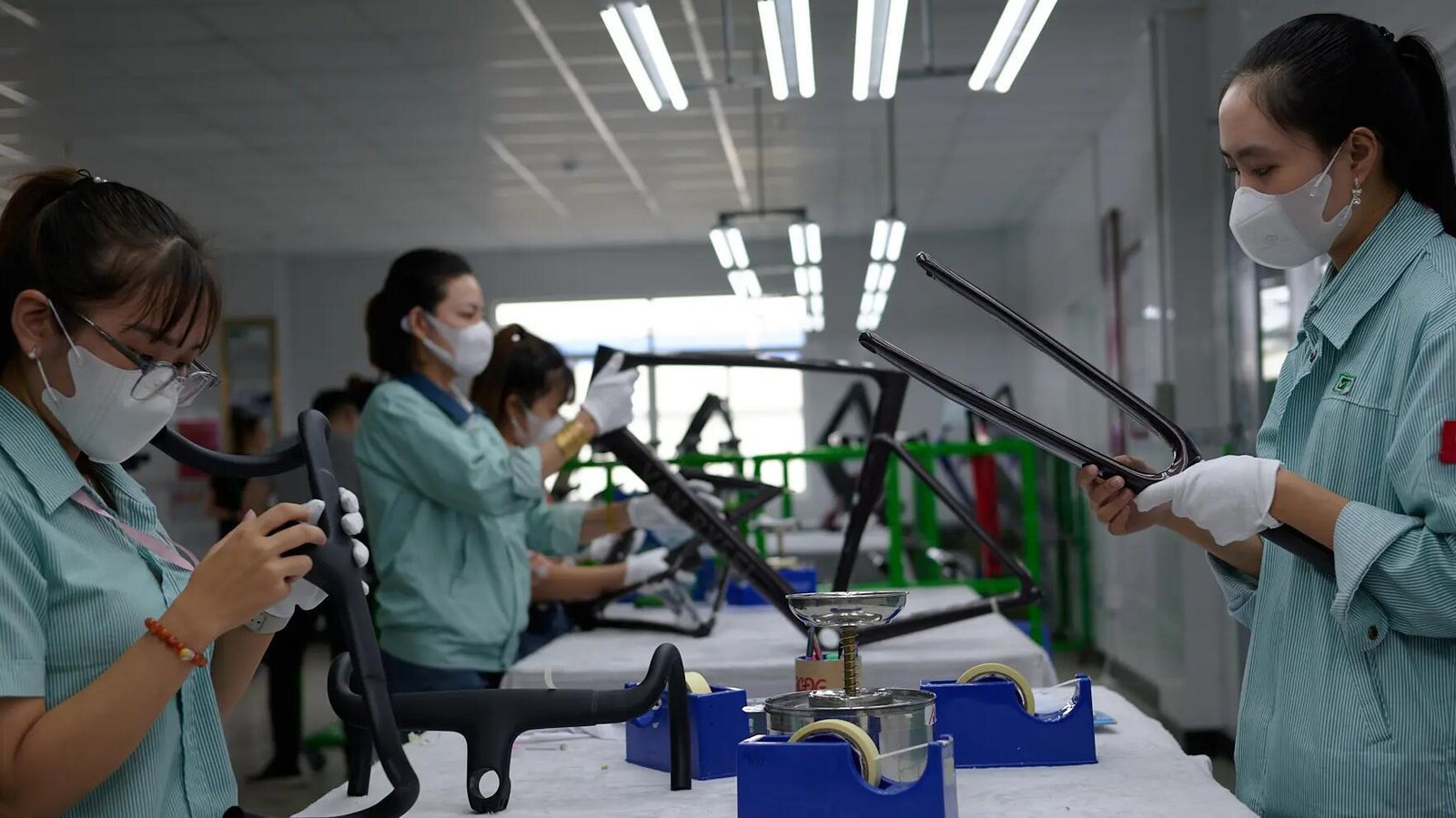
Are Chinese carbon bike frames safe? The answer most often given online is “it depends on the factory,” which is true but useless. This guide replaces that vague answer with a clear, factual map of how Chinese carbon manufacturing actually works in 2026, what the real quality risks are, and how a dealer or brand can verify a supplier without flying to Shenzhen.
We will not dodge the hard parts. There are real risks. There are also factories producing frames at quality levels indistinguishable from any premium brand on the market — because in many cases they are the same factories.
The majority of carbon bike frames sold globally — including a significant share of frames carrying European and American brand names on WorldTour grids — are manufactured in China and Taiwan. The question is not whether Chinese carbon manufacturing can produce premium-quality frames. It demonstrably does. The question is which Chinese factory you are buying from, and whether you have verified the controls that separate Tier 1 OEM-grade production from Tier 4 marketplace listings.
Quality varies by four tiers, which we map below. A dealer or brand that uses the 14-point checklist at the end of this article will reliably end up with Tier 1 or Tier 2 supply.
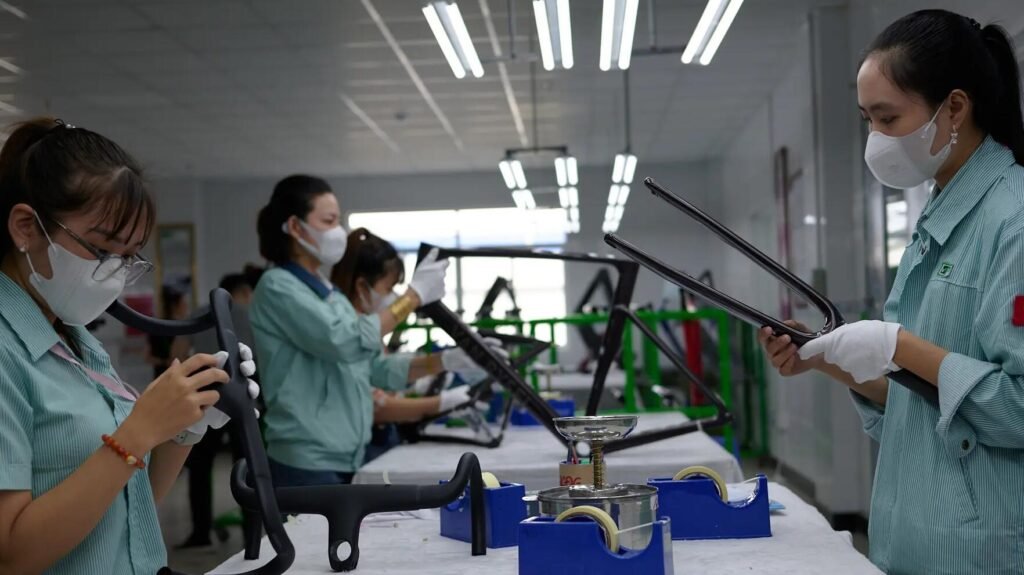
Carbon bicycle manufacturing in China clusters in a small number of regions, each with its own specializations:
Shenzhen and Dongguan (Guangdong): The largest concentration of premium carbon frame factories, including most of the operations that supply WorldTour-sponsor brands. Mature supply chains for prepreg, EPS cores, hardware, and paint.
Huizhou and Xiamen: Strong in mid-tier ODM platforms, increasingly moving into premium with newer facilities.
Tianjin: Historically the volume capital of China’s bike industry, mostly aluminum and steel, with growing carbon capacity in mid-tier segments.
Kunshan and Suzhou: Specialized carbon component suppliers (handlebars, seatposts, wheels) and emerging frame capacity.
Within these regions, factories sit on a spectrum from Tier 1 OEM operations supplying global brands to Tier 4 marketplace sellers offering decals-on-anything. Understanding the spectrum is the first step in vetting suppliers.
| Tier | Description | Typical clients | Pricing | Rejection rate |
|---|---|---|---|---|
| Tier 1 | OEM factories producing for global premium brands. Full traceability, in-house testing labs, multi-stage QC. | WorldTour-sponsor brands, premium global brands | High | Below 1% |
| Tier 2 | Strong ODM factories with private-mold capability, in-house engineering, accredited test reports. | Mid-to-premium DTC brands, established dealers, regional brands | Mid-to-high | 1–3% |
| Tier 3 | ODM factories selling open-mold platforms with rebranding. Limited engineering, third-party testing only. | Emerging brands, smaller dealers, online resellers | Mid | 3–7% |
| Tier 4 | Marketplace sellers (Alibaba storefronts, no factory verification, often trading companies). Inconsistent QC, frequent supplier-of-record swaps. | Individual buyers, very small resellers | Low | Highly variable, often 10%+ |
Sunremo operates as a Tier 1/Tier 2 hybrid: full ODM platform inventory with private-mold capability, in-house engineering and testing, rejection rate 3% documented frame rejection rate, and 3000 units monthly capacity of monthly output. Dealers can request our recent ISO 4210 reports and factory walkthrough video at any time.
Pretending Chinese carbon manufacturing has no risks is dishonest and unhelpful. Here are the failure modes that actually occur, and how each one is prevented at Tier 1/Tier 2 factories.
Insufficient resin content. Cheap factories under-resin layups to save material cost. The frame looks and weighs correct but fatigues prematurely, especially at the bottom bracket and head tube. Prevention: documented resin-to-fiber ratios, batch traceability on prepreg, in-process weight checks.
Layup schedule deviation. Workers skip plies or substitute lower-modulus fiber to hit time targets. Prevention: digital layup instructions, photo-documented layup at each station, supervisor sign-off per piece.
Cure cycle shortcuts. Reducing cure time or temperature increases throughput but compromises matrix consolidation. Prevention: oven temperature logging, cure profile audit trail, post-cure ultrasonic inspection.
Voids and delaminations. Caused by improper bagging pressure, bladder failure, or contamination. Prevention: post-cure ultrasonic scanning of every frame at the bottom bracket, head tube, and seat tube junctions.
Paint hiding cosmetic defects. Heavy filler under paint can mask repaired delaminations or surface cracks. Prevention: pre-paint inspection by an independent QC, paint thickness measurement, customer right to inspect bare frames pre-paint.
Counterfeit test reports. Non-accredited labs or fabricated reports. Prevention: only accept reports from CNAS, A2LA, TÜV, SGS, or Intertek; verify report number with the issuing lab directly.
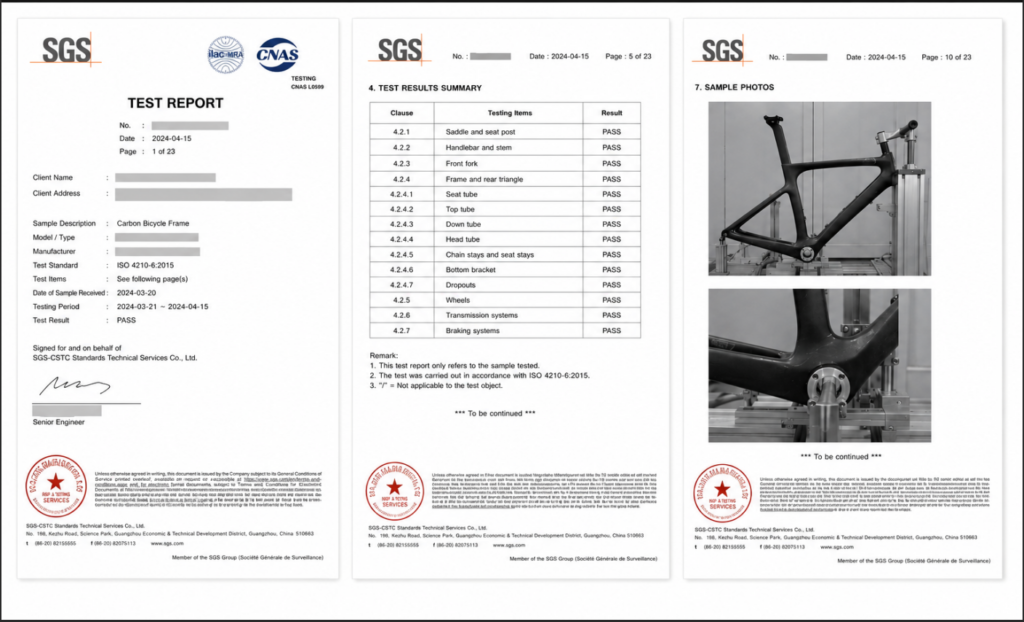
Test reports are dense documents. Most buyers skim them and miss the parts that matter. Here is what to actually read.
Issuing lab. Top of page 1. The lab name should be one you can find on CNAS, A2LA, or other accreditation body registries. If you cannot find the lab independently, do not trust the report.
Report number and date. Reports older than 24 months may not reflect current production. The report number should be traceable by emailing the lab.
Sample identification. The report should specify the exact frame model, size, and serial number tested. A report for “Carbon Road Frame Size M” with no model identifier is not useful — it could be from any frame the supplier ever made.
Test standard cited. ISO 4210-6:2015 is the relevant section for road frames. EN 14781 covers race bikes. The standard version year matters. Older standards have lower thresholds.
Test parameters. Look for fatigue cycles (100,000 minimum), load values, and pass/fail criteria. The report should show actual measured values, not just “pass.”
Failure mode notes. Even passing tests should document where stress concentrations appeared. This shows the lab actually ran the test rather than rubber-stamping.
Photographs. Reputable lab reports include photographs of the test setup and the post-test sample. Reports without photographs warrant follow-up.
Two dealers in two different markets ordered open-mold frames from two different Chinese suppliers in 2023. Both frames had nearly identical published geometry and similar pricing.
Dealer A worked with a Tier 1 ODM. Lead time was 75 days against a quoted 70. Frame rejection rate at incoming inspection was 0.8%. Two warranty claims in the first 18 months, both honored within 21 days, both root-caused to crash damage. Reorder rate from Dealer A’s customers: 32%.
Dealer B worked with a Tier 4 marketplace seller. Lead time was 110 days against a quoted 60. Frame rejection rate at incoming inspection was 12%, including three frames with visible voids at the bottom bracket. The supplier’s warranty response was 90+ days and ultimately required Dealer B to absorb the cost of replacements. By month 14, Dealer B had quietly stopped reordering.
The frames looked similar on listing photos. The total cost of ownership differed by 3-5x when factoring rejection rate, warranty handling, and customer churn.
Use this list before placing any order. Score each item yes/no. Anything below 12/14 should trigger additional due diligence.
In a Tier 1 or Tier 2 factory, the manufacturing process, materials, and testing standards are equivalent or identical to what produces European-branded premium frames — because in many cases the same factory produces both. The differences are in brand premium, marketing, and warranty network density, not in structural quality.
In Tier 3 and Tier 4 sourcing, quality varies widely and risk is real. The 14-point checklist above is the practical filter.
Are Chinese carbon bike frames as good as Taiwanese ones?
At the Tier 1 and Tier 2 level, the manufacturing standards are equivalent. Both regions supply premium global brands. Differences come from individual factory practices, not country of origin.
Why are some Chinese carbon frames so cheap on Alibaba?
Marketplace listings often come from trading companies aggregating excess inventory or pilot runs from various small factories. Pricing reflects unverified production with high variability in quality.
What is “open mold” carbon and is it safe?
Open-mold frames use existing tooling shared across multiple buyers. They can be perfectly safe when produced at a Tier 1/Tier 2 factory with proper QC. The risk is not the open mold itself but the factory producing it.
How do I verify a Chinese factory exists?
Search the business license number on China’s National Enterprise Credit Information Publicity System (gsxt.gov.cn). Cross-reference the registered address with satellite imagery. Request a live video tour with timestamped landmarks.
What is a normal frame rejection rate?
Tier 1 factories: under 1%. Tier 2: 1–3%. Tier 3: 3–7%. Anything above 7% is a quality control problem, not bad luck.
Do Chinese factories really make frames for premium European brands?
Yes. The carbon manufacturing supply chain has been globalized for over two decades. The brands themselves rarely advertise this, but it is well-documented across industry reporting.
What test standard should a Chinese carbon frame meet?
ISO 4210 is the international baseline. ISO 4210-6 covers road frames specifically, EN 14781 covers race bikes, and CPSC is required for sales in the United States. Premium suppliers test to all relevant standards.
Can I trust a test report from a Chinese lab?
Yes, if the lab is CNAS-accredited. CNAS has mutual recognition agreements with A2LA (US), UKAS (UK), and others, meaning a CNAS report is internationally recognized. Verify the lab is CNAS-listed at cnas.org.cn.
What is the typical warranty on a Chinese carbon frame?
Tier 1/Tier 2 manufacturers offer 5 years on frame structure and 2 years on paint, comparable to global premium brands. Tier 3/Tier 4 warranties are often shorter or unenforceable in practice.
Should I visit the factory before placing a large order?
For orders above 50w USD or for any private-mold development, an in-person or third-party audit is strongly recommended. For smaller pilot orders, video walkthroughs and accredited test reports are usually sufficient.
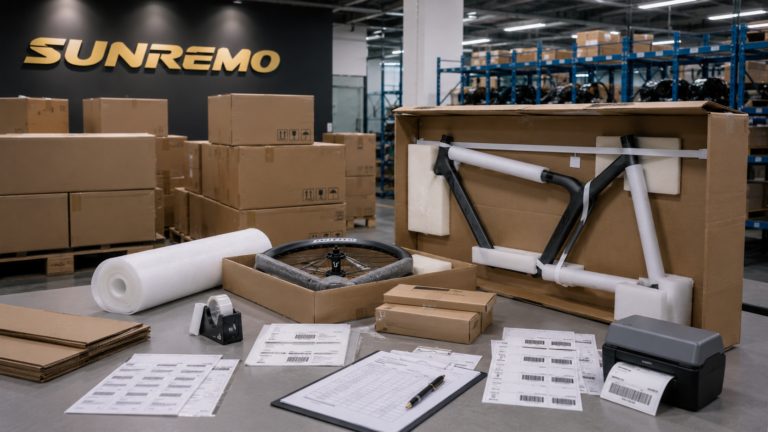
Before approving a sample or bulk order, use this checklist to review geometry, visual finish, assembly fit, documentation, testing claims, packaging, and pre-shipment inspection points.
For supplier questions, OEM/ODM project details, or private-label sourcing discussions, contact Sunremo through our contact page.