Subscribe now & get exclusive bike deals,
new arrivals alerts and pro riding tips!
Cycle green, stay fit, live better.

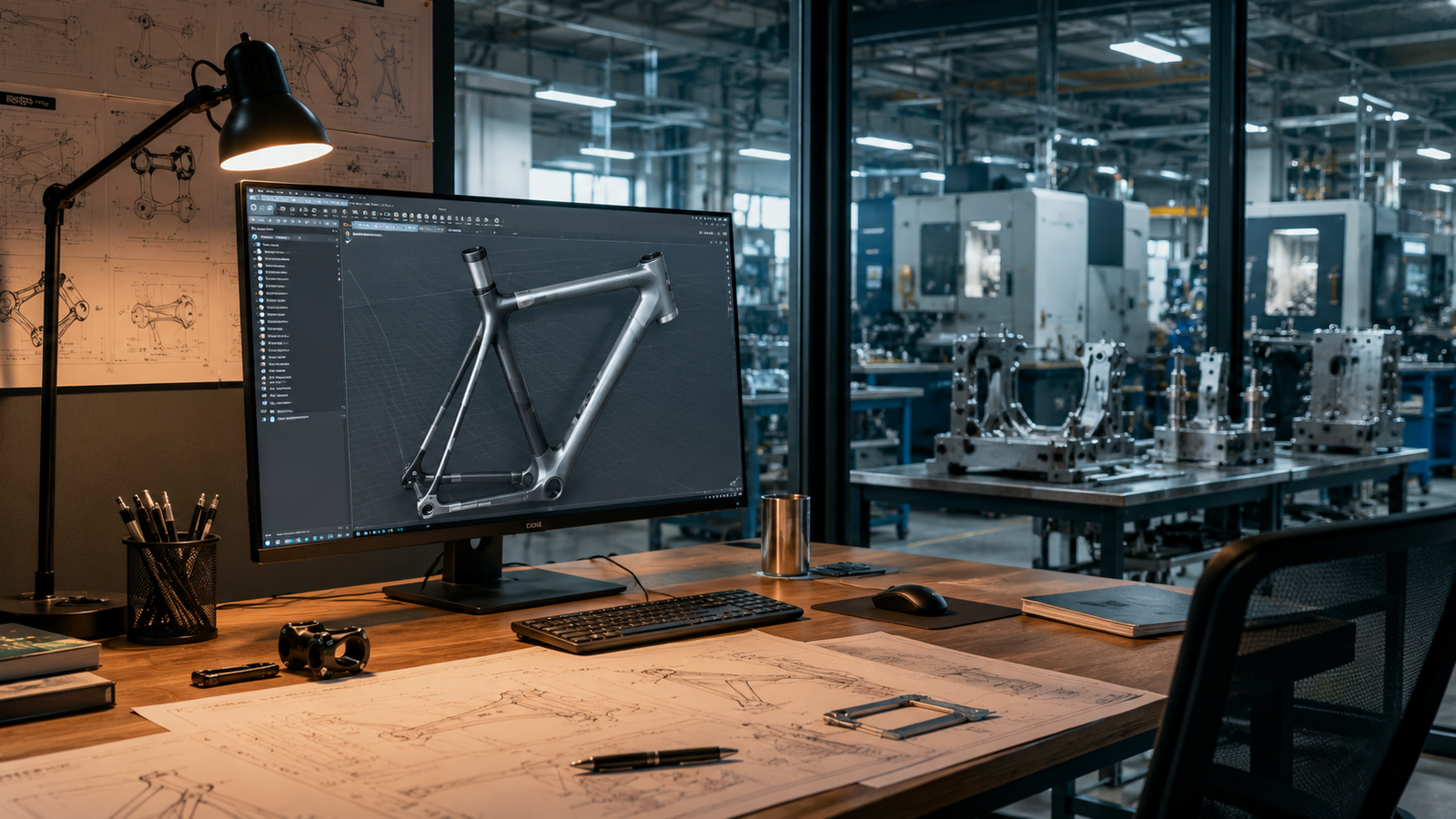
A practical carbon bike OEM/ODM manufacturing guide covering concept review, sample validation, production planning and buyer questions.
OEM (Original Equipment Manufacturing) means the buyer provides complete design files (CAD, geometry, spec) and the factory produces to those specifications. ODM (Original Design Manufacturing) means the factory contributes design and engineering, and the buyer brands and sells the result. A typical carbon bike OEM/ODM project takes 4–8 months from kickoff to first production batch, requires USD 15,000–60,000 in mold investment depending on frame complexity, and starts at MOQ 100–300 units per model. OEM gives full design ownership and IP control. ODM gives faster time to market and lower upfront engineering cost.
| Factor | OEM | ODM |
|---|---|---|
| Design ownership | Buyer | Shared or factory |
| Engineering input | Buyer-led | Factory-led |
| Time to market | 6–8 months | 4–6 months |
| Upfront cost | Higher | Lower |
| IP control | Full | Partial |
| Best fit | Established brands with design capability | Emerging brands needing technical support |
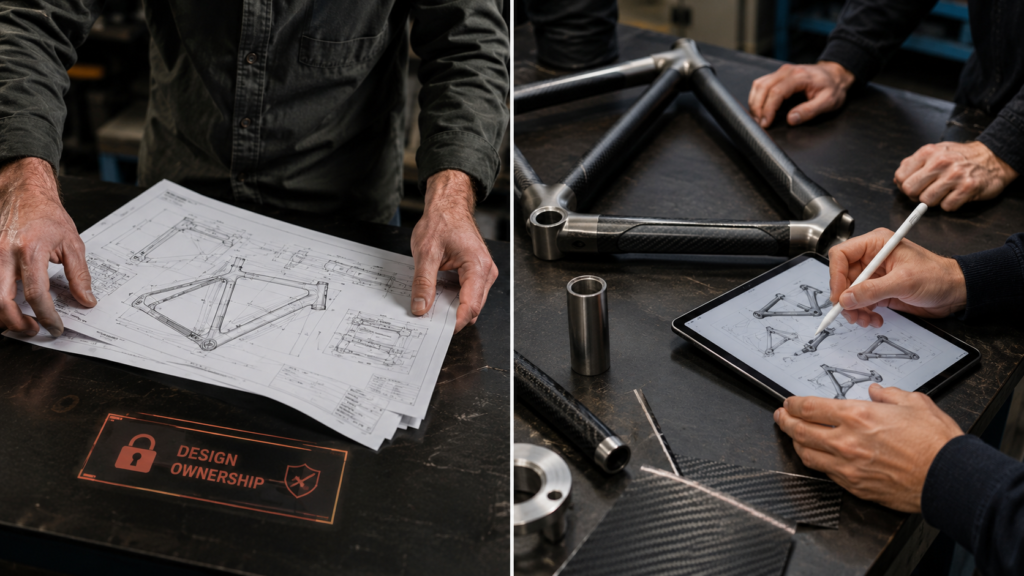
The terms get used interchangeably in casual conversation, but they describe two genuinely different manufacturing relationships, and confusing them leads to expensive misunderstandings.
OEM (Original Equipment Manufacturing) in the cycling context means the brand owns the complete design package: CAD files, geometry chart, layup schedule, tube shapes, dropout design, cable routing layout. The factory acts as a contract manufacturer, producing exactly what the buyer specifies. The buyer carries full responsibility for the design working as intended. Most established performance brands (Specialized, Trek, Cervélo, Pinarello) operate primarily as OEM relationships with their Asian manufacturing partners.
ODM (Original Design Manufacturing) means the factory contributes meaningful design and engineering work. The buyer might bring a brief, target geometry, performance goals, and visual direction, and the factory’s engineering team translates that into production-ready CAD, layup schedules, and tooling. The factory often retains some IP rights to the underlying design, though this is negotiable. Most emerging direct-to-consumer brands and regional brands operate as ODM relationships, sometimes evolving toward OEM as their internal capability grows.
A third category, OBM (Original Brand Manufacturing), refers to factories that develop and sell their own branded products. This is outside the scope of OEM/ODM and not relevant to most B2B buyers.
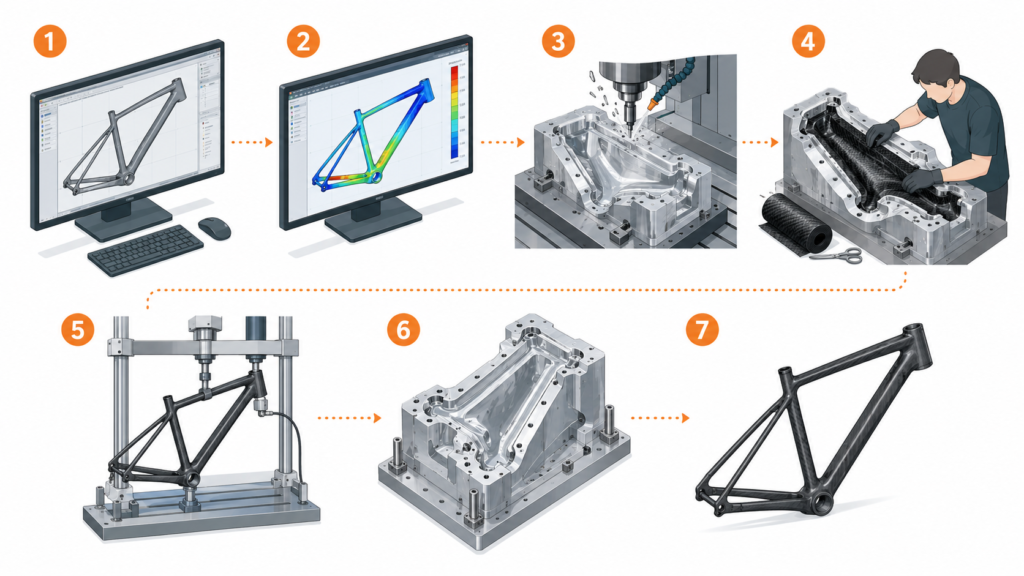
A complete carbon bike OEM/ODM project from kickoff to mass production runs through eight stages. Understanding the timeline helps brands plan launches realistically.
Stage 1: Project brief and feasibility (2–3 weeks)
The buyer submits a project brief covering target market, competitive positioning, key geometry parameters, weight targets, intended groupset compatibility, and brand requirements. The factory’s engineering team reviews feasibility and provides a preliminary quote covering mold cost, per-unit pricing at expected volumes, and indicative timeline.
Stage 2: Industrial design and CAD (3–6 weeks)
For OEM projects, the buyer provides finished CAD. For ODM projects, the factory’s design team produces 3D CAD models, geometry charts, and visual renders. Multiple revisions are normal at this stage. Lock the geometry and tube shapes before proceeding; changes after this point are expensive.
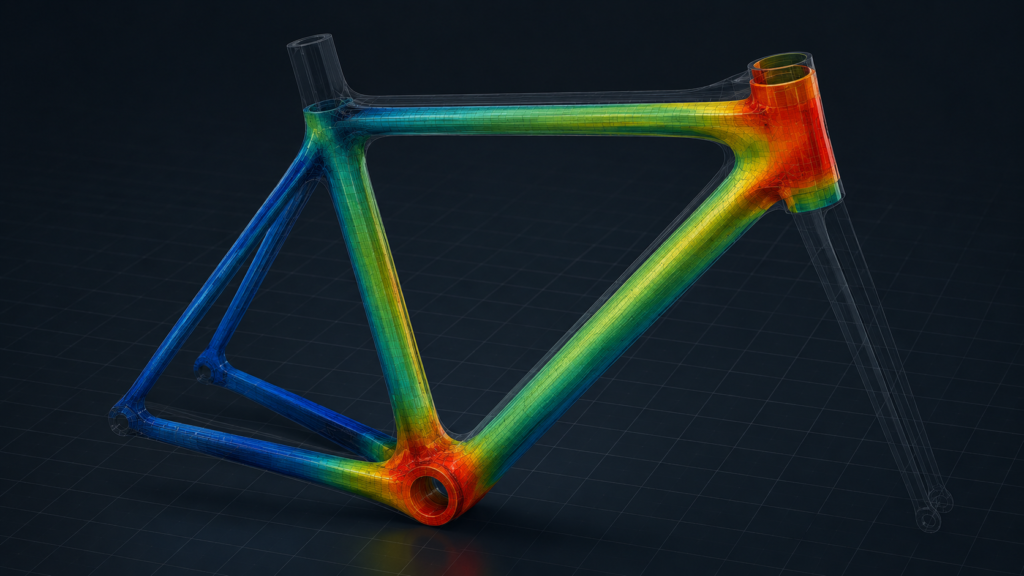
Stage 3: FEA structural simulation and CFD aero analysis (2–3 weeks)
Finite Element Analysis predicts stress concentrations under riding loads. CFD (Computational Fluid Dynamics) analyzes aerodynamic performance for aero-focused frames. These simulations identify weak points and validate the design before any tooling is cut.
Stage 4: Mold tooling (6–10 weeks)
CNC machining of aluminum molds for the main triangle, seatstay, chainstay, fork (if included), and dropout inserts. This is the longest single phase of the project and the largest single cost. Mold quality directly affects frame surface finish, dimensional accuracy, and production yield.
Stage 5: Prototype layup and testing (3–4 weeks)
The first prototype frame is laid up using the new mold. The frame undergoes EN 14781 fatigue testing (or ISO 4210 for general bicycles), impact testing, and crush testing. A reputable factory tests at least 3 prototype frames before declaring the design production-ready.
Stage 6: Design refinement and second prototype (2–4 weeks)
Almost every project requires layup or geometry adjustments after first-prototype testing. Common adjustments include reinforcing the head tube, adjusting bottom bracket stiffness, fine-tuning seatstay compliance. A second prototype validates these changes.
Stage 7: Pilot run (3–4 weeks)
A small batch of 10–30 frames produced under full production conditions. The pilot run validates the manufacturing process, QC procedures, paint quality, and assembly tolerances. Pilot frames often go to the buyer for marketing photography and dealer samples.
Stage 8: Mass production (4–8 weeks for first full batch)
Full production batch begins after pilot acceptance. Lead time depends on order volume, paint complexity, and current factory capacity.
Total realistic timeline: 5–7 months for a road or gravel hardtail OEM project. 6–8 months for a complex aero road or full-suspension MTB. Plan launch dates accordingly. Brands that promise customers a launch based on the factory’s optimistic 4-month estimate routinely miss windows.
Mold investment is the single largest line item in any OEM/ODM project. Realistic ranges in 2026:
| Frame Type | Mold Investment (USD) | Development Timeline |
|---|---|---|
| Road frame, rim brake | 15,000–22,000 | 4–5 months |
| Road frame, disc, internal routing | 18,000–28,000 | 5–6 months |
| Aero road frame | 25,000–38,000 | 6–7 months |
| Gravel frame | 20,000–30,000 | 5–6 months |
| MTB hardtail | 22,000–32,000 | 5–6 months |
| Full-suspension MTB | 35,000–60,000+ | 7–9 months |
| Track / TT / triathlon | 25,000–40,000 | 6–7 months |
| Kids carbon bike | 12,000–18,000 | 4–5 months |
Mold cost includes main triangle mold, seatstay mold, chainstay mold, dropout inserts, fork mold (if specified), and prototype layup costs. Industrial design and engineering files add USD 3,000–8,000 if not provided by the buyer.
Standard payment milestones split the mold fee:
Negotiate a mold fee rebate clause before signing. A fair industry term offers per-frame credit against mold cost as cumulative production exceeds an agreed threshold (commonly USD 10–25 per frame credited against mold fee until 50% recovered).
The technical handoff between buyer and factory determines whether the project moves smoothly or stalls.
For OEM projects, the buyer should provide:
For ODM projects, the buyer typically provides:
The factory’s design and engineering team handles the rest, with revision cycles built into the contract.
This is where projects most often go wrong. A handshake or vague contract creates real exposure when a sales manager leaves the factory and starts a competing brand using your design.
Non-disclosure agreement (NDA) signed before any design files are shared. The NDA should cover the project brief, all CAD files, prototype data, and commercial terms.
Mold ownership clause specifying exclusive use rights to the buyer. Standard industry practice keeps physical custody at the factory but grants exclusive use to the buyer. Confirm in writing that the mold cannot be used for any other buyer for the contract term plus a defined period after.
Design IP ownership specifying who owns the resulting design. For OEM, this should be the buyer unconditionally. For ODM, this is negotiable: some factories retain rights to underlying engineering know-how while granting exclusive commercial use to the buyer.
Design patent filing rights. The buyer should have explicit rights to file design patents (industrial design rights) in target markets. File before public launch in the EU, US, China, and Japan if those are key markets.
Non-compete clause preventing the factory from selling identical or substantially similar frames to competitors for the contract term. Define “substantially similar” carefully — vague language is unenforceable.
Mold transfer clause if relevant. By default, molds stay at the factory. If the buyer wants the right to physically relocate the mold (to another factory or in-house), this requires explicit clauses and usually a transfer fee.
Termination conditions specifying what happens if either party exits. Who keeps the mold? What happens to unsold inventory? What happens to design files?
A serious factory will sign a comprehensive IP agreement without resistance. Reluctance to sign is itself a warning signal.
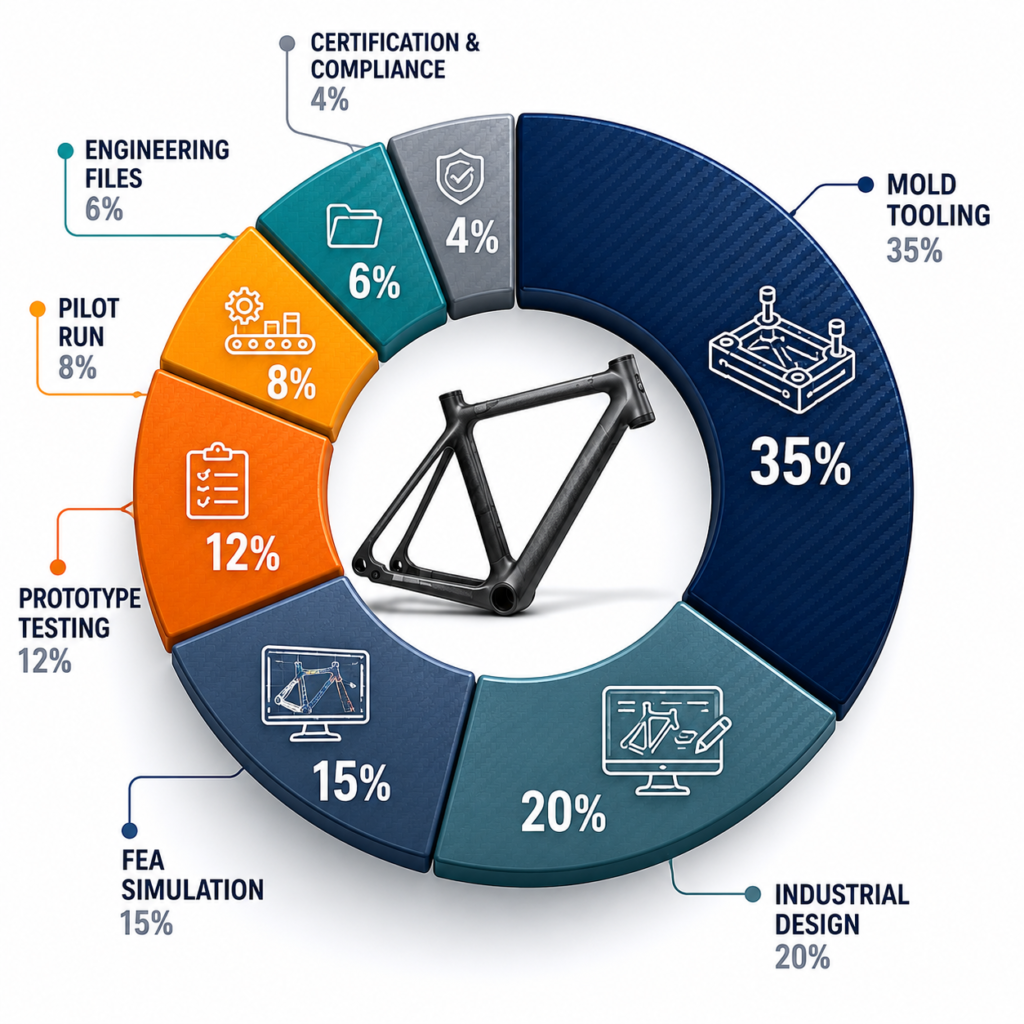
Total OEM/ODM project investment breaks down across several line items beyond mold cost:
| Line Item | Typical Cost (USD) |
|---|---|
| Industrial design (if not buyer-provided) | 3,000–8,000 |
| FEA/CFD simulation | 2,000–5,000 |
| Mold tooling | 15,000–60,000 (varies by frame type) |
| Prototype frames (3–5 units) | 1,500–3,500 |
| EN 14781 / ISO 4210 testing | 2,000–4,000 |
| Pilot run (10–30 frames) | per-unit production cost |
| Per-unit production cost at MOQ 100 | varies by spec |
| Per-unit production cost at MOQ 500+ | 8–12% lower |
For a road frame OEM project with USD 22,000 mold cost and USD 350 per-frame production cost, total project investment to first 100 units delivered is approximately USD 65,000–75,000 depending on testing and pilot details.
ROI calculation depends on retail price and margin structure. As a rough benchmark, a USD 22,000 mold amortizes across roughly 150–250 units at typical margins, meaning the mold is paid off within the first 1–2 years for a brand selling 100+ units annually.
“ODM means the factory does everything.” Not quite. The buyer still needs to make critical decisions: target geometry direction, brand positioning, paint and visual identity, spec choices, distribution strategy. Factories cannot make these decisions for you and should not.
“ODM is cheaper than OEM.” Upfront engineering cost is lower, but per-unit cost is similar at the same volume. The savings are in the engineering investment, not in production economics.
“ODM frames are lower quality than OEM.” False. The same factory produces ODM and OEM frames on the same lines using the same materials. Quality depends on the factory, not on the contracting model.
“My ODM design is uniquely mine.” Only if the contract explicitly grants exclusive use. Some factories develop ODM platforms that they offer to multiple buyers with cosmetic variations. Confirm exclusivity in writing.
“Once production starts, the factory handles everything.” No. Brands need ongoing involvement in QC, paint approval, packaging review, and shipping logistics. ODM does not mean hands-off.
Choose OEM when:
Choose ODM when:
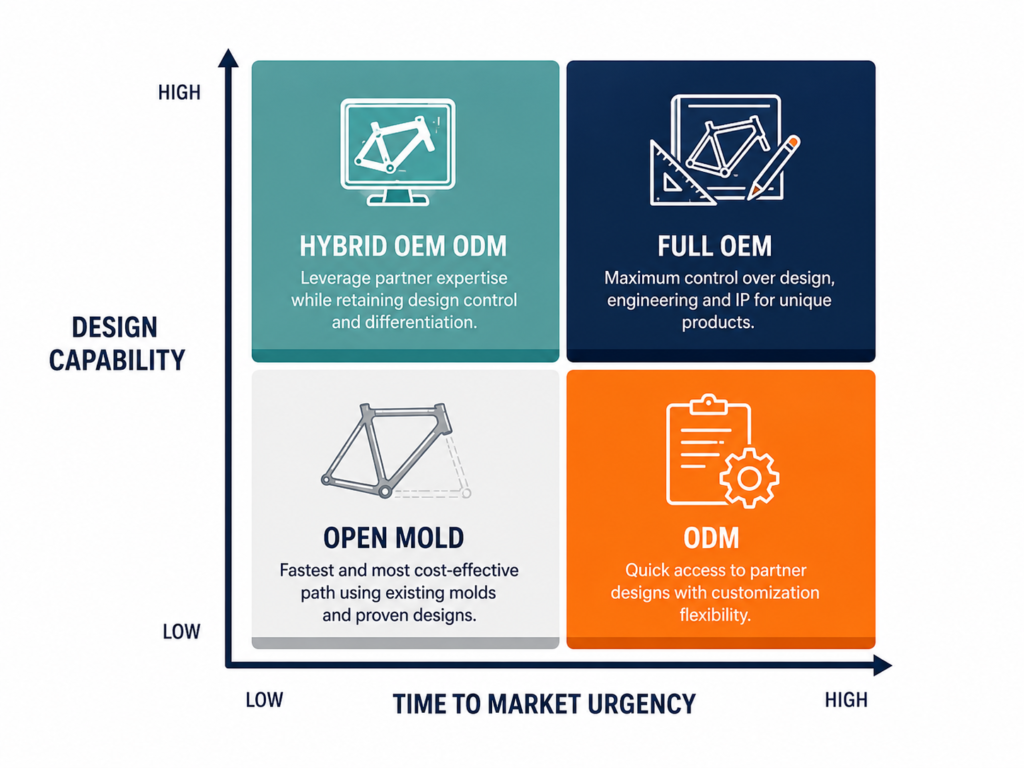
Many successful brands operate as hybrid OEM/ODM: handling industrial design and geometry in-house while relying on factory engineering for layup optimization and tooling. This balances design control with engineering efficiency.
Beyond the standard supplier vetting (covered in our guide on How to Choose a Carbon Bike Supplier), OEM/ODM projects require additional evaluation criteria:
Engineering team depth. Ask how many engineers the factory employs in design and FEA roles. Anything below 3–5 dedicated engineers means the factory is primarily a production shop, not an engineering partner.
Testing infrastructure. Verify in-house EN 14781 and ISO 4210 test rigs. Factories that send testing to external labs add weeks to development cycles.
Existing OEM portfolio. Reputable OEM factories produce for established brands. Ask which brands they have produced for (under NDA, they cannot disclose specifics, but they should be able to speak generally to portfolio depth).
Communication and project management. OEM/ODM projects require sustained communication over 6–8 months. Evaluate response time, English fluency of the engineering team, and project management discipline during the quote phase.
Payment flexibility and milestone structure. Factories that demand 100% mold payment upfront are higher risk. Standard milestones (50/30/20) protect both parties.
What’s the minimum volume to justify an OEM project?
At typical margins, mold cost amortizes across 150–250 units. Below 100 annual units, OEM rarely makes financial sense compared to open mold with custom paint.
Can I start with ODM and graduate to OEM?
Yes. Many brands do exactly this. Year one: ODM to validate market and learn manufacturing. Year two-three: develop OEM capability and design subsequent models with deeper engineering input.
Who owns the CAD files in an ODM project?
Negotiable. Default factory practice often retains underlying engineering files while granting buyer commercial rights. For brands building long-term IP, negotiate full ownership of project-specific CAD even in ODM relationships.
How much engineering input should I expect from the factory?
For OEM, primarily manufacturing engineering (layup optimization, tooling design, QC). For ODM, full design and engineering support including industrial design, geometry development, FEA, and CAD production.
Can I run multiple OEM projects with the same factory simultaneously?
Yes, established factories run multiple buyer projects in parallel. Confirm the factory has sufficient engineering bandwidth and confirm IP separation between projects.
What happens if testing reveals a design flaw?
The factory and buyer share responsibility for design correction. Layup revisions are typically the factory’s cost. Geometry or tube shape changes that require mold modification are typically the buyer’s cost. Specify this in contract.
Does Sunremo offer both OEM and ODM services?
Yes. We support both contracting models with dedicated engineering teams handling FEA, CFD, and layup design. Our typical project timeline is 5–7 months from brief to first production. Contact us for a project feasibility assessment.
For brands considering an OEM/ODM project, the first step is a feasibility assessment. Send your project brief covering target market, intended geometry direction, weight and price targets, and expected annual volume. We respond within 5 business days with a preliminary scope, mold cost estimate, and indicative timeline.
If you are still deciding between OEM/ODM development and starting with open mold inventory, see our companion guide on Open Mold vs Private Mold Carbon Bike Frames.
A practical OEM/ODM brief should define the buyer’s target market, bicycle category, geometry direction, sample expectations, branding requirements, expected annual volume and documentation needs. This allows the factory to separate design feasibility, tooling cost, sample timing and production planning instead of quoting from incomplete assumptions.